
Sex Offender Checks in Fremont County
The Colorado Bureau of Investigation has managed the Colorado Sex Offender Registry since 2002. Its public website can filter by Fremont County, name, city, ZIP, conviction category, or map area. Registry data updates hourly, while optional ZIP emails are weekly. Those are different freshness claims.
The site shows sexually violent predators, adult multiple sexual or violent felony offenders, adults who failed to register for a felony sex offense, and adults currently registered locally for a felony sex offense. It omits misdemeanor-only adults and juvenile adjudications from public web results.
Fremont Registry Is a Subset
The CBI registration unit says the public list is deliberately incomplete. Complete adult-area lists require an Adult Registered Sex Offender Request Form mailed to CBI with a fee. Fax and email are not accepted. A named juvenile request is free but controlled, requires a full name, written need, and affirmations, and returns only limited statutory fields.
A blank Fremont County web search is not a certificate that no other registrant lives nearby. The Department of Justice NSOPW search adds official cross-state coverage, while the Colorado product remains the source for its public state categories.
How to Search the Colorado Sex Offender Registry
Open the official agreement and read the accuracy and misuse terms. The advanced form needs at least one qualifying name or location field. Select Fremont in the County dropdown when no name is known.
- Read and accept the CBI search agreement.
- Choose advanced search or the map tool.
- Enter a name, city, ZIP, or select Fremont County.
- Open the official profile and read all identity and category fields.
- Use lawful CBI or local channels if a result needs clarification.
| Field Label | Type | Required | Notes |
|---|---|---|---|
| Last / First Name | Text, max 30 | Optional | Alias checkbox expands search |
| City | Text | Optional | Maximum 30 characters |
| ZIP Code | Text | Optional | Five digits |
| County | Dropdown | Optional | Select Fremont |
| Conviction Level | Dropdown | No | All, SVP, failure, multiple, felony |
| Map Radius | Select | Conditional | None, 1, 3, 5, or 10 miles |
Fremont Registry Search Screens
The agreement screen puts identity and lawful-use cautions first.
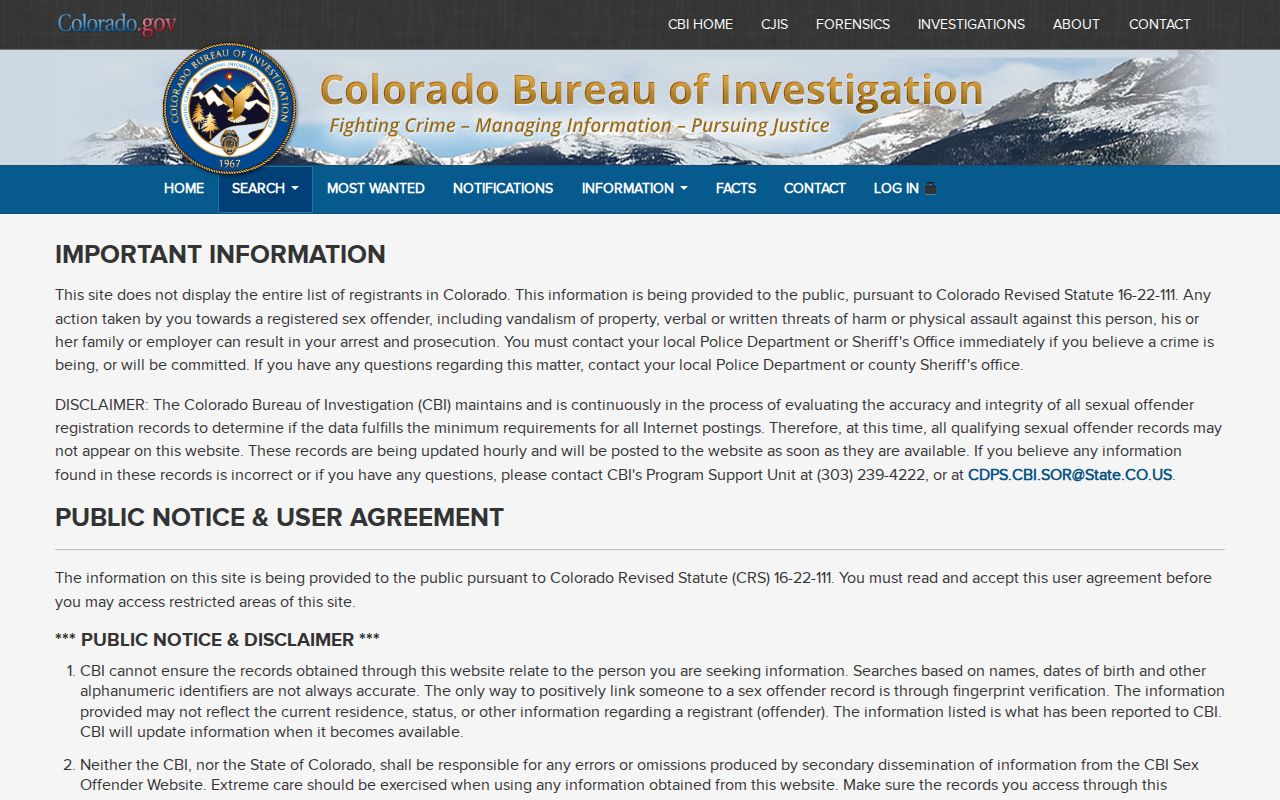
A name and birth date are leads, not positive identification.
The advanced form provides county and conviction-category filters.
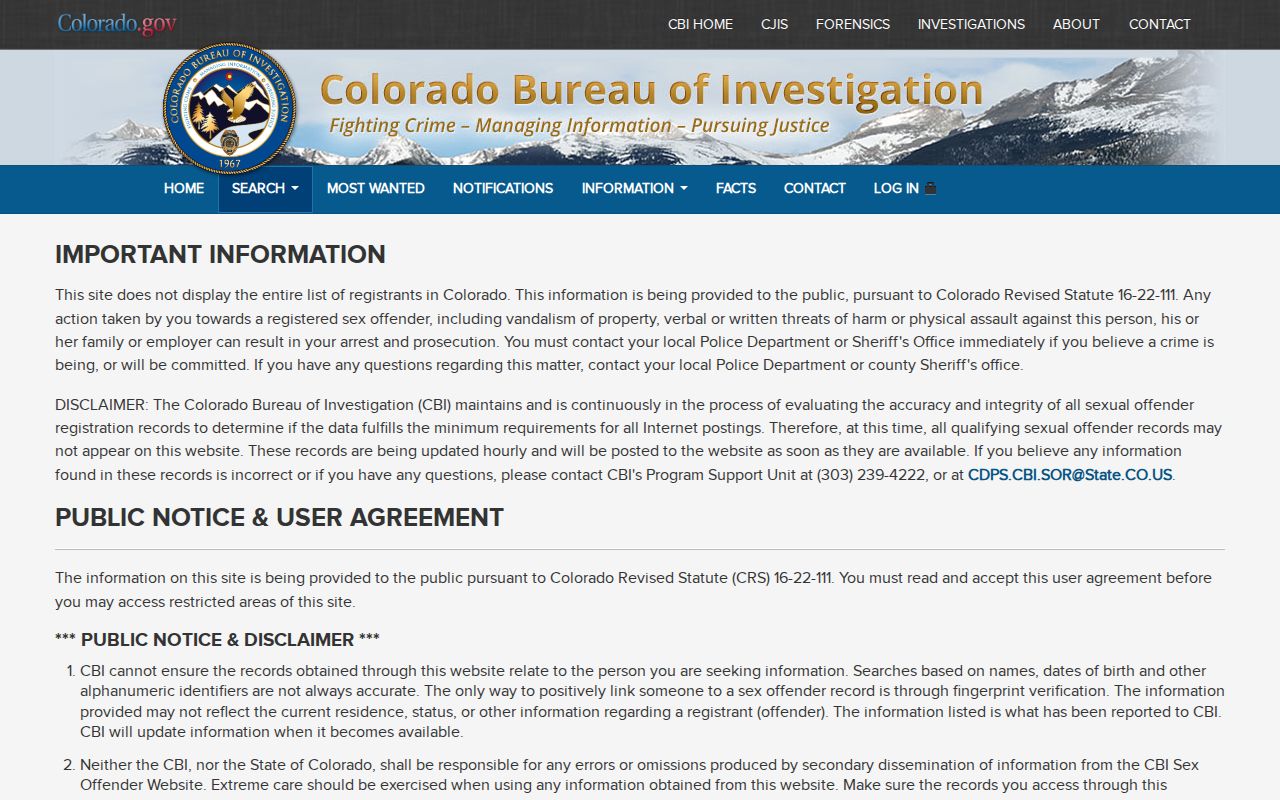
The county field supports an area search without a person's name.
The map search adds address and distance choices.
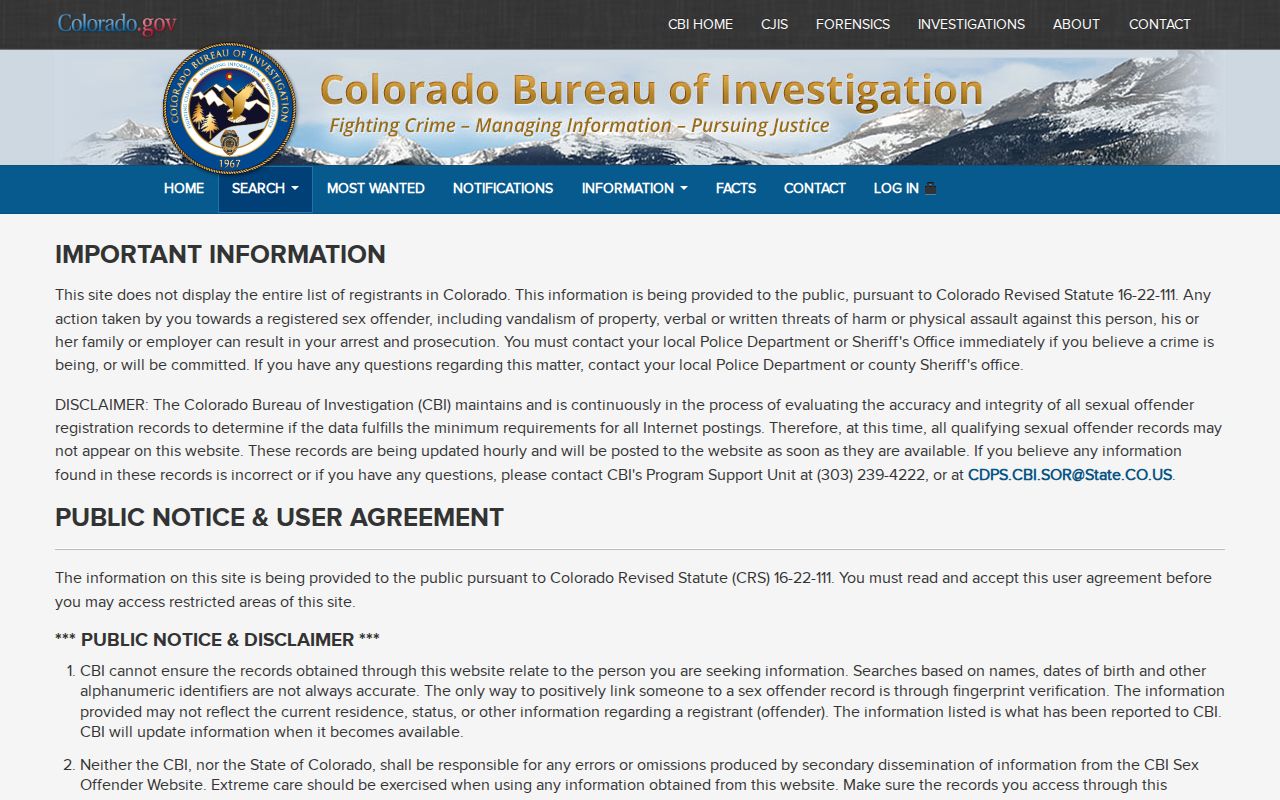
CBI warns that mapped points are not guaranteed, so do not treat them as survey-grade locations.
Inside a Fremont Registry Profile
A profile may show a photograph, full name, aliases, date of birth, current addresses, qualifying offense and date, and a category flag. It does not supply victim information or a complete rap sheet. The profile lists registration-triggering convictions rather than every contact with the justice system.
| Name & Aliases | Public identity fields, not fingerprint confirmation |
|---|---|
| Photo | Available official registry image |
| Registered Address | Current reported address or addresses |
| Offense | Registration-triggering conviction and date |
| Category | Felony, SVP, multiple, or failure flag |
| Status | Registration information released by CBI |
Fremont Name Matches Need Care
CBI says names, dates of birth, and alphanumeric identifiers are not positive identification. Fingerprints are. Compare the whole official profile and never act on a guess based on a similar name. The public registry also may not contain every qualifying record at every moment.
The official profile interface keeps results within the state system.
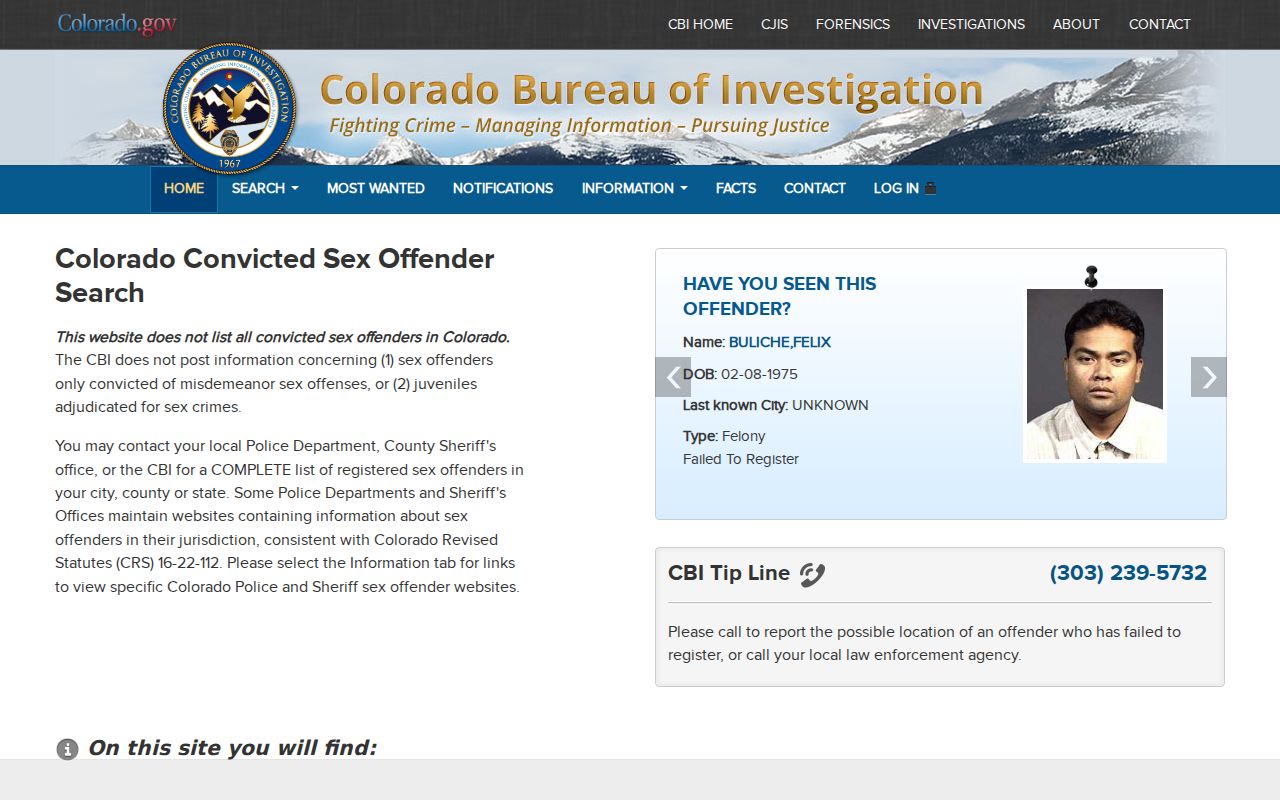
For wider arrest and disposition history, use the separate CBI criminal-history channel.
Colorado Registration Levels and Requirements
Colorado does not use public SORNA Tier I, II, and III labels. It publishes statutory categories. Registration is generally quarterly for sexually violent predators and annually for others, with event-based updates and exceptions. Petition timing depends on offense class and time since final release or discharge.
| Colorado category | Duration or removal | Visibility |
|---|---|---|
| SVP | Lifetime or ineligible category | Public |
| Adult felony registrant | Petition time varies | Public |
| Adult multiple offender | May be lifetime or ineligible | Public |
| Felony failure to register | Special compliant-period rule | Public flag |
| Misdemeanor-only adult | Complete-list route | Not on web list |
| Juvenile adjudication | Controlled termination rules | Not on web list |
Weekly Fremont ZIP Notifications
CBI's free service emails weekly changes for a subscribed ZIP. It is not instant and does not replace a fresh search. After three rejected emails, the account is disabled.
The official signup shows the notification channel.
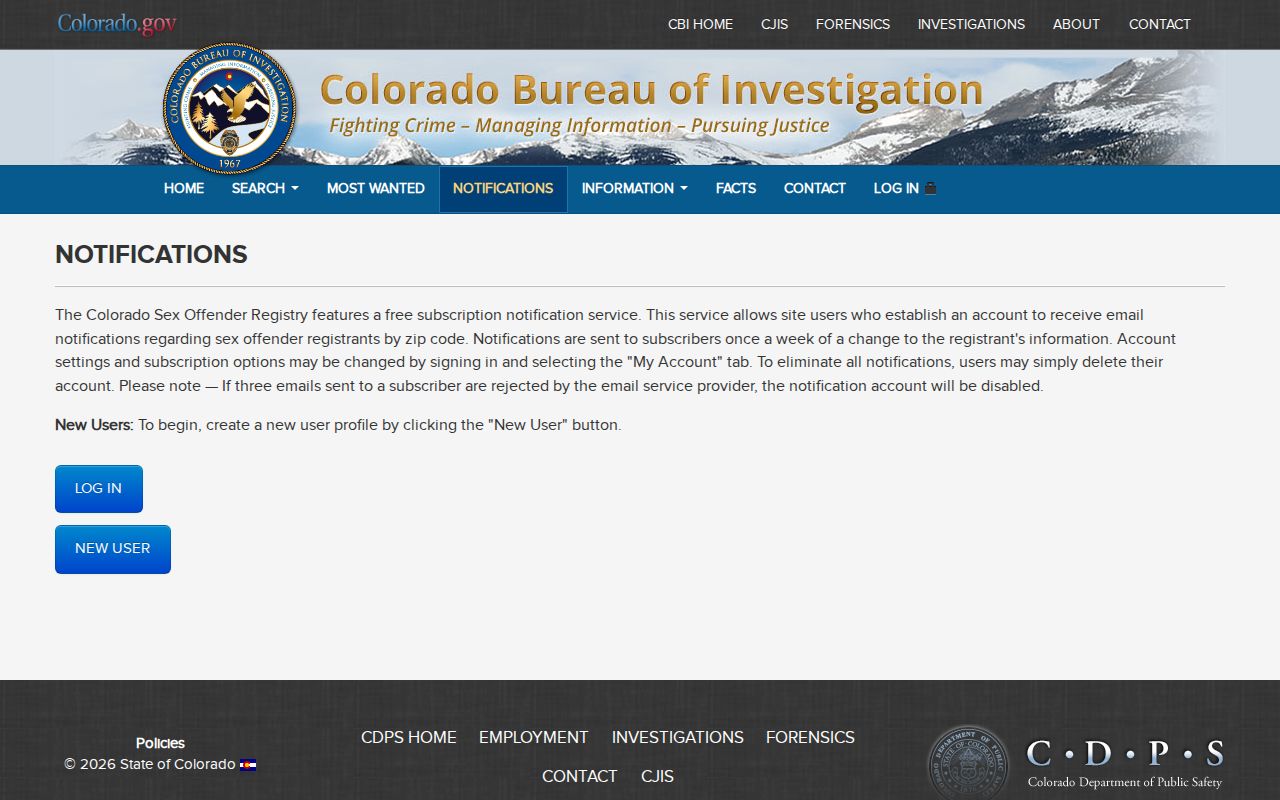
The service supports ongoing awareness without authorizing contact with anyone listed.
Community Notification and Lawful Use
Registry information supports personal, family, neighborhood, and community awareness. It is not permission to confront, follow, publish, shame, threaten, intimidate, or retaliate. Call 911 for an emergency. Report suspected noncompliance to local law enforcement or CBI's tip line at 303-239-5732.
The CBI unit is at 690 Kipling Street, Suite 3000, Denver, CO 80215; 303-239-4222; cdps.cbi.sor@state.co.us. CRS 18-9-310.5 makes specified misuse and false juvenile-request statements an unclassified misdemeanor with a fine up to $1,000 per violation.
Misuse is a crime: Harassment, intimidation, threats, or retaliation based on registry information may violate CRS 18-9-310.5 and bring a fine up to $1,000 per violation.
The CBI registration-unit page gives current complete-list and reporting rules.
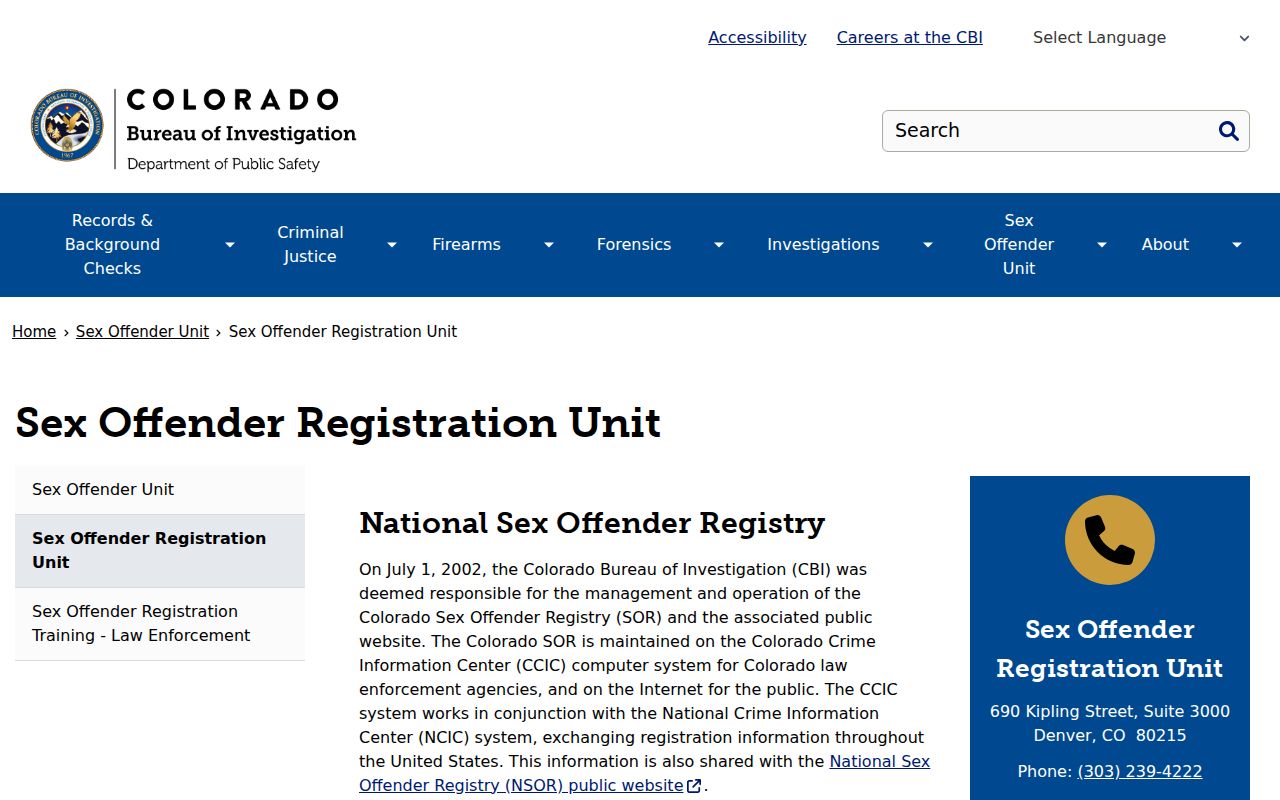
Use that official source when the public search cannot answer the lawful question.
Legitimate agencies do not call and demand gift cards or immediate money while threatening arrest. Verify any claimed registry issue through published CBI or local law-enforcement numbers. A profile match does not authorize a private person to test compliance, visit an address, or contact a household. Trained officials handle investigation and enforcement.
For a complete adult-area inquiry, follow the mail-only CBI request instead of trying to infer hidden registrants from public profiles. For a named juvenile inquiry, the requester must meet the controlled written-request terms. Juvenile output can include status, names or aliases, birth date, current addresses, an available photo, and the qualifying offense and date, but victim information remains excluded. These channels protect both lawful access and statutory confidentiality.
Removal from registration is also offense-specific. Under Colorado law, some class 1 through 3 felony cases may become petition-eligible after twenty years from final release or discharge. Certain class 4 through 6 felony matters or specified class 1 misdemeanors use a ten-year period, while other misdemeanors may use five years. Sexually violent predators and certain serious or multiple convictions can remain ineligible. Successful deferred matters and failure-to-register postings have distinct rules. Current statutes and court orders control, not a summary label on a search result.
Fremont County readers should also separate local registration from national searching. The Colorado registry provides the state record and local address fields. NSOPW searches participating jurisdictions across state lines. Neither tool replaces an emergency call, an official report of suspected noncompliance, or fingerprint-supported identification. Use the smallest lawful channel that answers the safety question and preserve the distinction between a public registry fact and an unverified assumption.
Map points need context. CBI does not guarantee placement, so a pin is not proof of a parcel boundary, residence duration, or presence at a given moment. Compare the profile address and current status before relying on the map.
Registry categories are statutory display labels, not risk scores. A felony, multiple-offender, failure, or sexually violent predator flag does not predict future conduct. A misdemeanor-only adult may be registered yet absent online. That is why complete-list and controlled-request channels remain separate from the public website.